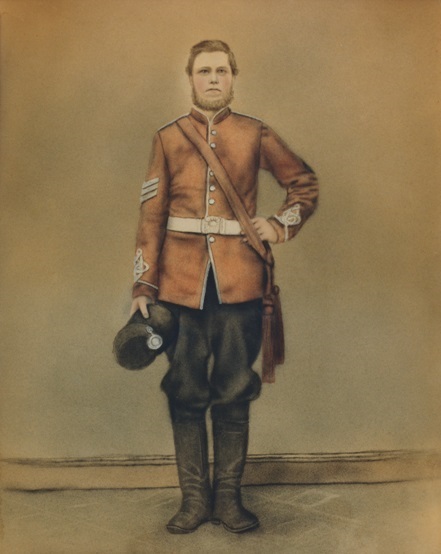
HEATH/MORRISON: The soldier in this portrait is Robert Morrison, a sergeant in the Number 6, Wardsville [Ontario] Infantry Company, 26th Battalion of Middlesex Militia. During the Fenian Raids of 1866, Morrison’s Company was sent to Sarnia, Ontario where an attack was expected.
Presumably, Morrison’s portrait was based on a much smaller photograph – possibly a tintype. The size and format of the portrait appears to be an example of mail-order portraiture. In the 1880s and 1890s, photographs were sent to studios in large cities for enlargement in charcoal. The mixture of coloured chalk and watercolour suggests that this portrait might have been a special order, as most works of this kind were done in black and white.
The process of adding colour would have been speculative, which probably accounts for some of the discrepancies in the uniform as detailed by Mark A. Reid of the Canadian War Museum in 1979.
Your ancestor appears to be wearing a standard issue 9-button tunic typical of the sort worn during the period of the Fenian Raids. As a Sergeant, his tunic should be scarlet, lower ranks wore red tunics until 1873 but such niceties were not always observed in the Militia. The collar and cuffs should be dark blue, not red/scarlet as painted, and the piping on collar, cuffs, rear skirts and front closure would have been white. The trousers were officially described as Oxford mixture, in effect a very dark blue, with a 1/4 inch scarlet welt down the inside seam. A munificent Canadian government expected its militia-men to provide their own underclothing, socks and foot-wear[,] so all types of official and civilian patterns were no doubt seen on parade.
The symbols of Sgt. Morrison’s status are the three chevrons of white worsted lace on his right upper arm (on both arms in Rifle, Fusilier Highland regiments only) and the crimson worsted sash worn over the right shoulder. The latter distinction is still worn by infantry and non-commissioned officers of the Canadian Forces today and during the Victorian period it was worn virtually all the time. The shako depicted in the portrait is unclear but would probably have been the so-called second “Albert” pattern worn in the British Army between 1855-1861. It was made of coarse felt, 5-1/2” high in front and 7-1/8” at the back and re-inforced with [a] 1/8” wide leather band at the top and another, 5/8” wide, a the base. The front peak was only 2-3/8” deep, unlike the one portrayed in your portrait, while the rear “peak” was a mere 3/8” deep. The white “blob” illustrated was a white-over-red woollen ball tuft (2” in diameter) which sat in a brass socket protruding from the centre top of the shako…
The belt was made of 2” wide buffalo leather, kept white with a noxious solution called pipe-clay, and closed with a brass locket and clasp fastening, approximately 1-7/8” in diameter. A leather frog, holding the 17” Enfield bayonet, was worn over the left rear. A 2-12” wide white pouch belt would have been worn over the left shoulder to support a black ammunition pouch over the right rear.
In conclusion, much of the equipment used and worn by the Militia of the Fenian Raids period was old or obsolete. Many units and individuals were somewhat haphazardly equipped, with perhaps only undress caps and tunics being issued, necessitating the wearing of civilian trousers, etc… Considering these circumstances, your ancestor Sgt. Morrison is very well turned out, with a nearly complete uniform. My own opinion is that he wore his trousers tucked into his boots to give a more “martial” appearance and not because he was mounted.
The person responsible for commissioning the portrait is not known, although it might have been Morrison himself as he lived until 1900. After Morrison’s death, the portrait passed to his son, Charles Stuart Morrison.
In later years, the family farm was registered in the name of Altha Morrison, who was Charles S. Morrison’s wife. Upon her death in 1924, the farm and the contents of the farm house – including the portrait of Sergeant Morrison – passed to Samuel St. Clair Morrison instead of his father, who was deemed incompetent.
After Samuel S. Morrison’s death in 1979, the portrait was included in the estate auction of his Hatelie Hill farm near Wardsville, Ontario. I, however, discovered the portrait in the barn before the auctioneer got to it. As a great, great-grandson of Sergeant Robert Morrison, I was allowed to keep the portrait. Russell R. Morrison identified the portrait at the time of the auction. As a child, he remembered seeing the portrait hanging in the parlour of his family’s farm house. Since Russell R. Morrison was born in 1895, his earliest memories of the portrait probably date to about 1905.
The original plaster frame did not fare well, and had all but disintegrated by the time of the auction. The portrait itself was only slightly damaged. After a limited restoration in 1989, including surface deacidification, the portrait was archivally framed two years later. It was donated to the Canadian War Museum in 2012.
 Ancestors of Ancestors